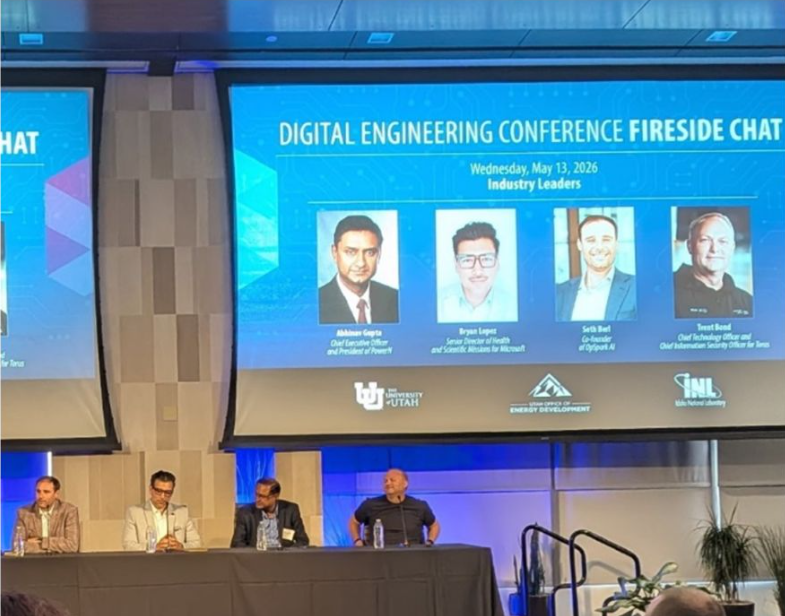
Recently, I’ve had the opportunity to join two exceptional industry panels on the future of AI, digital engineering, and infrastructure transformation.
At ASCE Structures Congress (Boston) — alongside leaders from Thornton Tomasetti and Pennoni — the focus was on how AI and connected digital workflows are beginning to reshape engineering and construction.
In Salt Lake City, with leaders from Microsoft, Torus, and OpSpark AI, the conversation went deeper into the convergence of industrial AI, real-time project intelligence, and data interoperability.
Across both discussions, one insight stood out clearly:
The next wave of infrastructure and energy development won’t be driven by incremental improvements. It will be driven by intelligent execution platforms that connect engineering, construction, and operations into a continuously learning system.
As demand accelerates across nuclear, advanced manufacturing, grid modernization, and mega-scale infrastructure, the industry can no longer rely on:
– Fragmented workflows
– Delayed feedback loops
– Static project controls
The advantage will go to platforms that can:
– Transform construction data into operational intelligence
– Reduce execution risk in real time
– Compress schedules on complex capital projects
– Build scalable institutional knowledge across programs
At PowerN, this is the future we are building toward. We are still early in the adoption of AI in industrial sectors but the trajectory is now clear.
The shift from static execution to intelligent, adaptive delivery has begun.
Grateful to the leaders driving these conversations forward and excited for what’s ahead.
#AI #DigitalEngineering #ConstructionTech #Infrastructure #Engineering #Nuclear #DigitalTwin #RealityCapture #Innovation #PowerN #DICE2026 #ASCE